Is commercial solar worth it for a West Midlands business?
For most commercial sites with a reasonable roof area and daytime electricity use, the answer is often yes, though the margin varies considerably.
The logic is straightforward. A business running machinery, lighting, refrigeration or office equipment during the day is using electricity at exactly the time a solar array is generating it. Unlike a home, where occupants are often out during peak generation hours, a commercial premises usually has a high daytime load that can absorb most or all of what the panels produce. That self-consumption is where the financial case is strongest.
It tends to work well for: - Warehouses and manufacturing units with large roofs and consistent daytime machinery loads. - Retail premises with high lighting and refrigeration demand through trading hours. - Offices with air conditioning, IT infrastructure and steady Monday-to-Friday occupancy. - Agricultural and rural businesses across Worcestershire and Warwickshire with open roof space.
The case is weaker for premises that run mainly evenings or nights (low self-consumption), buildings with heavily shaded or structurally compromised roofs, or businesses on very short leases where payback runs beyond the tenancy. The honest starting point is an energy audit: how much you use, when you use it, and what your roof looks like.
How much does commercial solar cost for a business?
The figures below are typical market ranges drawn from industry data. They are not a Djuka price list, and your actual cost depends on a site survey and written quote.
- A 10 to 30 kWp system (small offices, retail units) typically runs somewhere around £15,000 to £40,000.
- A 30 to 100 kWp system (medium warehouses, schools) is roughly £40,000 to £120,000.
- A 100 kWp and larger system (industrial, logistics) sits from around £120,000 upwards.
Those are indicative market figures only. What moves the number: - System size. Bigger arrays cost more overall, but the cost per kWp usually falls as the system scales. The right size is set by your roof area and your consumption, not by going as big as possible. - Roof type and access. Flat commercial roofs often use ballasted frames rather than roof penetrations, which affects material and labour. Pitched roofs, ground-mount and older roofing each have different requirements. - Three-phase supply. Most commercial premises have three-phase power, which allows larger inverter capacity. Confirming your supply at the outset avoids surprises later. - Battery storage. Adding storage raises the upfront cost but can improve self-consumption, particularly on variable load profiles. - Grid connection. Larger systems may need a formal application to the Distribution Network Operator before install, which adds time and sometimes cost depending on local grid capacity.
What is the payback and return for a commercial system?
Payback varies considerably. As a general guide, many commercial systems pay back somewhere between five and twelve years, depending on system size, tariff, self-consumption rate and whether battery storage is included. The range is wide because the variables are significant, and any installer who quotes a precise payback figure without seeing your site and energy bills should be treated with caution.
What shapes the return: - Self-consumption rate. The more of your generation you use on site, the better the return. Electricity you use yourself avoids grid rates; electricity you export earns a much smaller rate under the Smart Export Guarantee. - Your current tariff. Higher unit rates mean greater savings per unit generated, so businesses on higher commercial tariffs tend to see stronger returns. - Performance over time. Quality panels degrade slowly across a 25 to 30 year lifespan, so a well-specified system keeps generating well beyond the payback period.
Businesses can often claim capital allowances on commercial solar, which can improve the case by reducing the effective upfront cost. Tax rules in this area do change and depend on your business structure, so confirm the current position with your accountant before factoring any tax relief into your projections.
One note on savings estimates: any figure quoted as a typical annual saving is a projection built on assumptions. Treat it as a guide to the order of magnitude, not a guarantee, and ask any installer to show you the assumptions behind their numbers.
What roofs and premises suit commercial solar?
Not every building is equally suited, and a structural and shading assessment is an essential first step before any system is designed.
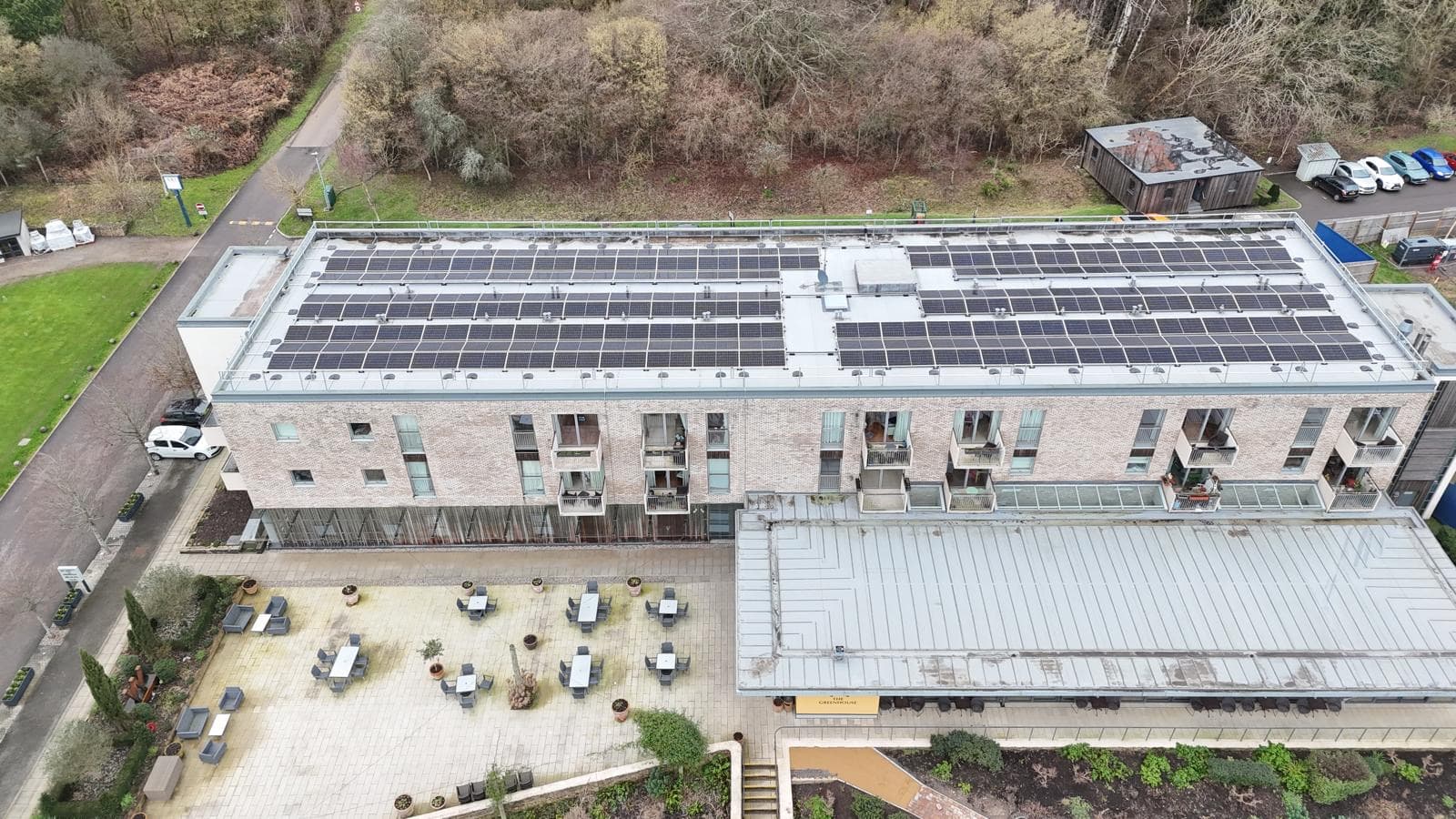
- Large flat roofs are often the best candidate. Warehouse and industrial roofs across the West Midlands, from logistics parks near Birmingham to units around Redditch and Bromsgrove, offer large unobstructed surfaces. Flat roofs let panels sit at an optimised tilt on ballasted frames, without roof penetrations.
- Pitched roofs work well where pitch and orientation are favourable. South-facing pitches between 30 and 45 degrees perform best, though south-east and south-west are still viable, and east-west arrays spread generation across the day.
- Ground-mount suits agricultural land and sites with limited roof space but available land. Planning requirements vary, so this is assessed early.
A structural survey is not optional for commercial solar. Roofs must be assessed for load-bearing capacity before any mounting system is specified, which matters especially for older industrial buildings. Most commercial premises are on a three-phase supply, which affects inverter selection, and shading from neighbouring buildings, rooftop plant or trees can meaningfully reduce output, so a proper on-site shading analysis beats a glance at satellite imagery.
How does the Smart Export Guarantee work for businesses?
The Smart Export Guarantee (SEG) is a government-backed scheme that requires larger licensed energy suppliers to offer a tariff for electricity exported to the grid. A business with a solar installation can register for an SEG tariff and get paid for surplus generation it does not use on site.
Key points for commercial users: - Eligibility. The system must be installed by an MCS-certified installer and hold MCS certification. This is a hard requirement, non-MCS installations cannot access the SEG. - Export rates vary by supplier and change over time, and the SEG rate is typically lower than the unit rate you pay to import, which is why maximising self-consumption matters more than maximising export. - A smart meter capable of half-hourly metering is needed to take part. Most commercial premises already have one, but it is worth confirming.
The SEG is a useful additional income stream, but it should not be the main driver of the case. The real return comes from the electricity you generate and use yourself, not from what you export.
Should a business add battery storage or EV fleet charging?
Neither is compulsory, but for many businesses they improve the overall return and operational resilience.
Commercial battery storage lets you capture surplus daytime generation and use it in the evening, overnight or during peak grid demand. The benefits go beyond simple self-consumption: - Peak-shaving. Many businesses pay demand charges based on their peak grid draw. A battery can trim those peaks by supplementing supply during high-demand periods, lowering costs independently of solar generation. - Business continuity. A battery paired with solar adds a degree of resilience against grid outages, which matters where downtime is costly. - Time-of-use optimisation. On time-of-use tariffs, you can charge from the grid overnight when it is cheap and discharge during expensive daytime peaks, saving even on cloudy days.
Businesses running a vehicle fleet have a strong incentive to integrate EV charging with solar. Charging vehicles during the day from your own generation can substantially cut fleet running costs, and the synergy between an array and a fleet charging hub is often better than either investment alone. The key considerations are charger capacity, vehicle numbers, charging patterns and whether the existing electrical infrastructure can support the load. As NAPIT-registered electricians, we design and install the full electrical infrastructure for commercial charging, not just the chargers. Our guide to the best home battery systems covers the underlying battery technology in more detail.
What does the install process look like for a business?
Commercial installs are more involved than domestic ones, but a well-managed project minimises disruption to your operations: - Site survey and design. A surveyor assesses the roof, electrical infrastructure, shading and consumption data, then designs the system to your site and energy profile. - Structural survey. A structural report is typically required before mounting is finalised, confirming the roof can safely carry the load. - DNO application. For systems above a certain capacity, a formal application to the Distribution Network Operator is needed before install. This can take several weeks, so it starts early. - Installation. Work is carried out by our own team, often phased for larger systems to fit around your operations. Most commercial installs happen without shutting down the business. - Commissioning and certification. The system is tested, commissioned and certified under MCS, which is required for SEG registration. - Handover and monitoring. You get a walkthrough of the monitoring system, an explanation of normal performance, and the warranty position on panels, inverters and mounting hardware.
It is always worth asking an installer whether they use their own team or subcontract the work. We use an in-house team throughout, so the people who design the system are the ones who install it, which keeps quality and accountability in one place.
How do you choose a commercial solar installer in the West Midlands?
A commercial project needs more scrutiny than a domestic one, because the stakes are higher and the technical requirements more complex. Before you sign anything, check: - MCS certification. This is the standard for grid-connected solar and the gateway to the Smart Export Guarantee. Ask any installer to confirm their MCS certification for the work. - Electrical competence. A commercial install involves significant electrical work, so the installer should be a registered electrical contractor in their own right, not a solar company that subcontracts the electrical side. - Insurance-backed guarantees. Check whether the workmanship guarantee is insurance-backed, so your warranty survives even if the installer stops trading. - Written, itemised quotes. A reputable installer breaks down system components, labour, DNO costs and any structural survey separately. A vague or verbal quote is a warning sign. - References and reviews. Ask for references from comparable commercial projects and check independent review platforms.
Djuka Electrics is NAPIT-registered, MCS-certified and carries IWA insurance-backed guarantees on every installation. We hold a 4.9 out of 5 rating from 82 Trustpilot reviews and provide free, written, itemised commercial quotes with no hidden costs. Based in Beoley near Redditch, we serve businesses across Birmingham, Coventry, Worcester, Solihull, Bromsgrove, Stratford-upon-Avon, Warwick and the wider West Midlands. To request a free commercial quote, call 01527 337155.