How much does battery storage cost by brand and size?
The table below shows typical fully installed costs for the systems we fit most frequently. All prices are at 0% VAT and assume installation on a property that already has, or is simultaneously having, solar panels installed. Retrofitting a battery onto an existing solar system without any other work typically adds £300 to £500 due to the additional commissioning time.
| System | Usable capacity | Typical installed cost | Cost per kWh | Warranty |
|---|---|---|---|---|
| Fox ESS (5 kWh range) | ~5 kWh | £3,500 to £4,500 | £700 to £900/kWh | 10 years |
| GivEnergy 5.12 kWh | 5.12 kWh | £3,800 to £4,500 | £740 to £880/kWh | 10 to 12 years |
| GivEnergy 9.5 kWh | 9.5 kWh | £5,500 to £6,500 | £580 to £685/kWh | 10 to 12 years |
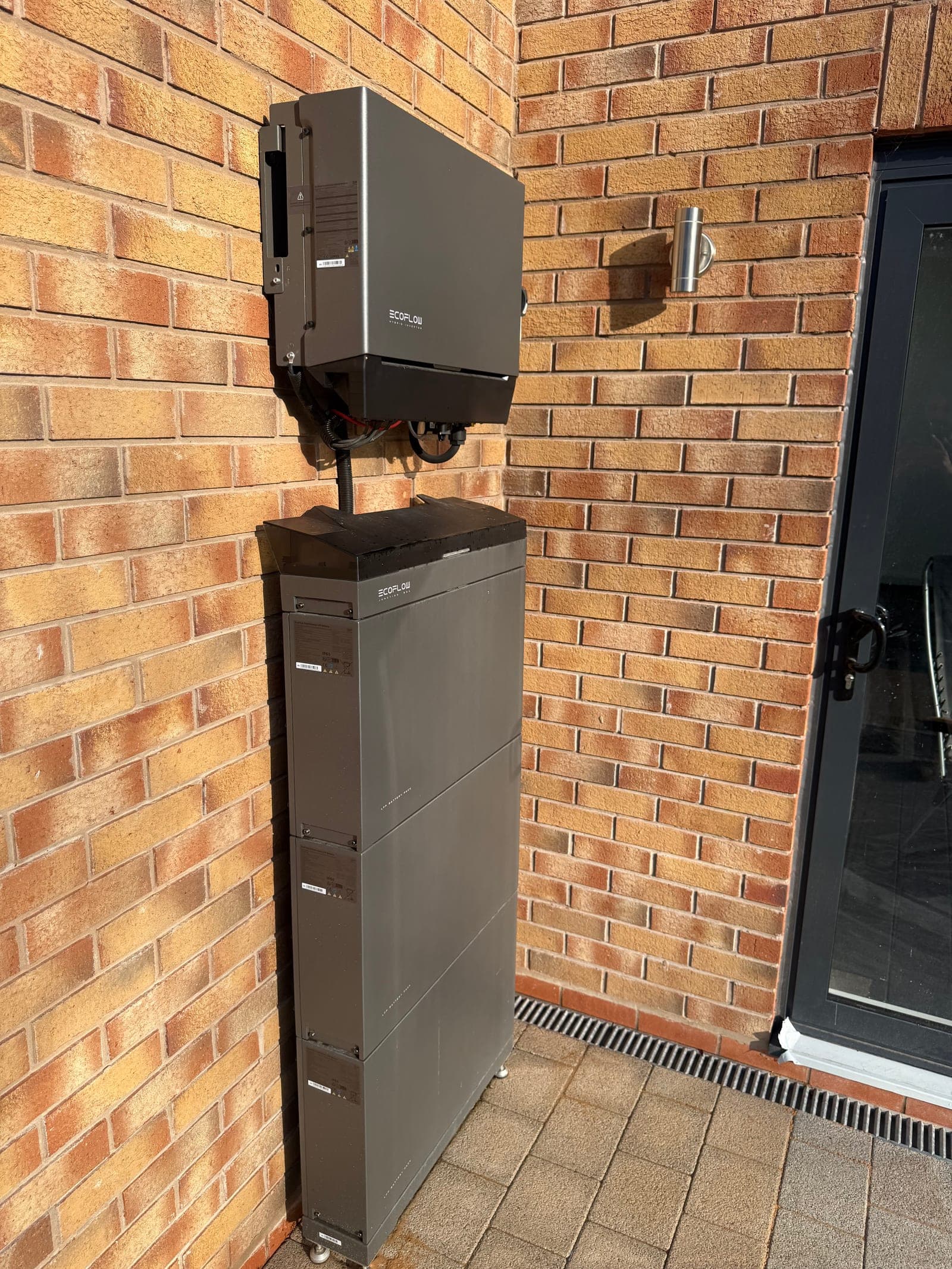
| EcoFlow DELTA Pro Ultra | 6 to 15 kWh (modular) | £4,500 to £7,500 | £500 to £750/kWh | 5 years |
| Tesla Powerwall 3 | 13.5 kWh | £7,500 to £9,000 | £556 to £667/kWh | 10 years |
These are market-context ranges, not fixed quotes. Your actual price depends on the specific variables covered in the next section. Use these figures to sense-check quotes you receive, not to budget to the pound.
Fox ESS
Fox ESS holds a significant share of the UK residential market, offering strong value particularly at the 5 kWh entry point. Their modular architecture means capacity can be expanded later by adding battery modules, which suits homeowners who want to start conservatively and scale up. The 10-year warranty covers both the battery cells and the inverter unit.
GivEnergy 5.12 kWh and 9.5 kWh
Note (June 2026): GivEnergy Ltd entered administration in April 2026 and is no longer trading or honouring warranties. The prices below are kept for market context; we no longer quote new GivEnergy installs and would point new buyers to the Tesla Powerwall 3 or Fox ESS.
GivEnergy has become one of the most popular choices for UK installers due to competitive hardware pricing, a well-regarded monitoring app, and strong UK-based technical support. The 5.12 kWh unit suits smaller households or those pairing with a modest solar array. The 9.5 kWh Gen 3 system is the sweet spot for most 3 to 4-bedroom homes with a 4 to 5 kWp solar system, providing enough capacity to store a full day's excess generation for evening use.
The cost-per-kWh advantage of the 9.5 kWh over the 5.12 kWh is meaningful. You pay roughly 20 to 25% more in total but get nearly double the storage, which is why the larger unit typically offers a faster payback for households with higher evening consumption.
EcoFlow DELTA Pro Ultra
EcoFlow takes a different approach: it is a modular, portable-first system that can also be hardwired as a permanent home battery. The advantage is flexibility and a lower entry cost for smaller storage needs. The trade-off is a shorter 5-year warranty compared to the 10-year terms on GivEnergy and Fox ESS, which is worth factoring into a long-term cost calculation.
Tesla Powerwall 3
The Powerwall 3 is the premium option and commands a premium price, but the comparison is not straightforward. Unlike the other systems in this table, the Powerwall 3 includes a built-in 11.04 kW hybrid inverter. If your existing system would otherwise require a separate hybrid inverter (typically £800 to £1,500 of additional hardware), the Powerwall 3's headline price gap narrows considerably. It also carries an unlimited-cycle warranty with a guarantee of 70% capacity retention at 10 years. See our David Clarke Tesla Powerwall 3 case study for how the system was specified and installed on a Redditch property.
How much does a 10 kWh solar battery cost?
A 10 kWh solar battery typically costs between £5,500 and £7,000 fully installed in the UK in 2026, at 0% VAT. Cost scales with usable capacity, but not in a straight line: a large share of the job is fixed labour, wiring, and DNO paperwork that costs the same whether the battery is 5 kWh or 15 kWh. That is why the cost per kWh usually falls as capacity rises, and why mid-range sizes tend to offer the best value.
| Usable capacity | Typical installed cost (2026) | Best suited to |
|---|---|---|
| 5 kWh | £3,500 to £4,500 | 1 to 2-bed homes with a modest solar array |
| 10 kWh | £5,500 to £7,000 | 3 to 4-bed family homes, the most common choice |
| 13.5 kWh | £7,500 to £9,000 | Larger homes, or homes with an EV or heat pump |
| 15 kWh and above (modular) | £8,000 to £11,000 | High-usage households wanting whole-home backup |
These are market-context ranges at 0% VAT, not fixed quotes. A battery for solar panels sits at the lower end of its band when fitted alongside a new solar system, and slightly higher as a standalone retrofit. The variables below explain why two quotes for the same capacity can still differ by £1,000 or more.
What affects the final installed price?
This is where most online cost guides fall short. They publish a headline figure for a battery and leave out the variables that routinely add £500 to £2,000 to the job. Here is what every reputable installer will assess before quoting.
AC coupling vs DC coupling
How the battery connects to your solar system is one of the most significant technical and cost variables.
- DC coupling connects the battery directly to the solar panels via a hybrid inverter, before the electricity is converted to AC. It is more efficient (typically 95%+ round-trip) and is the preferred method on new solar-plus-battery installations.
- AC coupling connects the battery on the AC side of your existing inverter. It is the standard approach when retrofitting a battery onto an existing solar system, because it does not require replacing your current inverter. It is slightly less efficient and needs its own battery inverter, but it is often the only practical option for retrofit work.
DC coupling on a new install is typically included in the combined solar-plus-battery price. AC coupling on a retrofit may require additional hardware and wiring that adds £200 to £600 to the job.
Consumer unit upgrades
Your consumer unit (fuse board) must have a spare way (circuit space) to accommodate the battery circuit. Many older consumer units, particularly those not upgraded in the last 10 to 15 years, are either full or are older split-load boards that do not meet current BS 7671 standards for a new high-load circuit.
A consumer unit upgrade typically costs £400 to £700 and is subject to 20% VAT as a general electrical work item, separate from the 0% VAT that applies to the battery installation itself. It is not a cost that can be avoided if the board requires it; it is a safety and compliance requirement.
Cable runs
The distance and route between your battery location and consumer unit directly affects labour time and materials cost. A battery in a utility room next to the consumer unit is straightforward. A battery in a detached garage, or one that needs cables run through a loft, under floorboards, or across a long external wall, takes longer and uses more cable. A long or complex cable run typically adds £150 to £500, depending on distance and access.
DNO notifications (G98 and G99)
Every grid-connected battery installation in the UK must be notified to or approved by the local Distribution Network Operator (DNO). The standards are set out in the G98 and G99 Engineering Recommendations. The route depends on the system's AC output rating:
| Standard | Applies to | Process | Timescale |
|---|---|---|---|
| G98 | Systems up to 3.68 kW AC per phase | Fast-track notification | 28 days |
| G99 | Systems above the G98 threshold | Full application with pre-approval | 30 to 90 days |
For most residential battery installations, G98 applies and the notification is handled by the installer. G99 is typically required for larger systems, particularly where the combined output of solar and battery exceeds the threshold. MCS-certified installers handle all DNO notifications on your behalf. If a quote does not mention DNO notification, ask whether it is covered.
Battery location and access
Ground-floor utility rooms and garages are the easiest locations. Loft installations, first-floor plant rooms, or properties with restricted access add time and sometimes require additional mounting hardware. Most batteries weigh between 50 kg and 130 kg, so access for installation is a genuine logistical factor.
Retrofit vs new install
Adding a battery to a brand-new solar installation at the same time as the panels is significantly cheaper than retrofitting later. The marginal cost of adding a battery during a new solar panel installation is typically £1,000 to £1,500 less than commissioning the same battery as a standalone job, because scaffolding, electrical access, and DNO paperwork are already being handled in the same visit.
Does battery storage qualify for 0% VAT?
Since 1 April 2022, the UK government has applied a 0% VAT rate to the installation of energy-saving materials in residential properties, including solar panels and battery storage. This is confirmed to remain in place until 31 March 2027, after which the rate is expected to revert to 5% under current legislation. Solar Energy UK's guidance on the VAT rules sets out the detail, and the Energy Saving Trust provides an overview of current incentives.
For a typical battery installation costing £6,000, the 0% rate saves £1,000 compared to the standard 20% rate. On a £9,000 system, the saving is £1,500. It is applied automatically by your installer on qualifying jobs; there is no form to fill in.
What qualifies for 0% VAT
- Battery storage installed alongside solar panels (DC or AC coupled).
- Battery storage retrofitted onto an existing solar installation.
- The battery hardware, inverter, mounting, cabling, and all associated labour.
What does not qualify
- Consumer unit upgrades are classified as general electrical work and attract 20% VAT.
- EV charger installations are charged at 20% VAT (a separate category).
- Standalone battery installations with no solar connection are subject to 20% VAT under current HMRC rules, because batteries only qualify when installed as part of a solar system.
Important: if you are installing a battery without any existing or new solar panels, your installer should make clear that 20% VAT applies. The saving on the battery-only side of the job disappears, which can add £700 to £1,200 to the cost compared to the figures in this guide.
The VAT deadline is a genuine reason to act before the end of 2026 if you are planning an installation. Booking a survey now does not commit you to anything, but it does ensure your installation can be completed within the 0% window if you decide to proceed.
What does battery storage cost in Worcestershire and the West Midlands?
We are based in Redditch and the majority of our battery installations are in Worcestershire, south Birmingham, Bromsgrove, Solihull, and the surrounding areas. A few property-specific patterns in this region regularly come up on surveys and are worth knowing before you request a quote.
Redditch new-town properties
Redditch was developed as a New Town from the late 1960s onwards, and a significant proportion of the housing stock dates from that era. These properties, particularly the semi-detached and terraced homes across Church Hill, Winyates, Matchborough, Woodrow, and Batchley, frequently have original consumer units that have not been upgraded since the 1980s or early 1990s.
The practical consequence is that a battery installation on a Redditch new-town property has a higher-than-average likelihood of needing a consumer unit upgrade, simply because the existing board is full or is a type that does not safely accommodate a new high-load circuit. When we survey a property in these areas we assess the consumer unit as part of the visit, and if an upgrade is needed it is quoted as a separate, itemised line at its actual cost before you commit to anything.
Other local considerations
- Birmingham and Solihull properties from the 1930s to 1960s often have long cable routes from the meter to the proposed battery location, particularly in larger detached homes where the utility area is at the back.
- Rural Worcestershire properties (Evesham, Pershore, Upton upon Severn) sometimes have older DNO infrastructure where a G99 application is required even for a modestly sized system, because the local grid section already carries generation from nearby solar.
- Bromsgrove and Droitwich new-build estates from the 2000s onwards generally have modern consumer units with spare capacity, making battery retrofits more straightforward.
For any property in our service area across the West Midlands and Worcestershire, the survey visit is where these variables are identified and costed properly.
Why don't we publish fixed prices?
Some installers publish fixed prices online. We do not, and it is worth explaining why, because the reason is directly relevant to whether you can trust the number you are given.
A fixed published price can only be accurate if every installation is identical. They are not. The variables covered in this guide (consumer unit condition, cable route length and complexity, coupling method, DNO route, battery location, and whether solar is being installed at the same time) all move the final number. An installer who publishes a fixed price is either:
- Quoting for the best-case scenario and hoping your property fits it, or
- Building enough margin into the headline figure to absorb all eventualities, which means straightforward jobs are overpriced.
Neither approach serves the customer well. The first leads to surprises after you have committed; the second means you pay for complexity you do not have.
Instead, every enquiry gets a free, written, itemised quote following an in-person or video survey. The quote breaks down hardware, labour, any required electrical work (such as a consumer unit upgrade), DNO notification, and commissioning as separate line items, so you can see exactly what you are paying for and why. There are no hidden costs added after you sign. You can read how this worked in practice in our Nikki Martin solar and battery case study, where the full system specification and costs are published.
What do you need ready for an accurate quote?
If you are based in Worcestershire, the West Midlands, or the surrounding areas, we will visit your property, assess your consumer unit, identify the best battery location and cable route, confirm which coupling method applies, and send you a written, itemised quote at no charge and with no obligation. All installations are carried out by our own in-house team, MCS-certified and NAPIT-registered, the same engineers from survey through to handover.
To make your free battery storage quote as accurate as possible, it helps to have ready:
- Your postcode and property type (house, flat, new-build, period property).
- Whether you already have solar panels, and the inverter make and model if you know it.
- Where you would ideally like the battery installed (utility room, garage, hallway).
- Roughly how much electricity you use per month, if you have a recent bill to hand.