LFP vs NMC: which battery chemistry is better?
Every battery in this guide uses lithium iron phosphate (LFP) chemistry, and that is not a coincidence. Understanding why LFP has become the dominant chemistry for home storage helps you evaluate any system you encounter.
LFP (Lithium Iron Phosphate)
LFP uses an iron phosphate cathode, which gives it a more stable chemical structure than other lithium chemistries. For a home battery, the practical implications are significant:
- Safety: LFP has a thermal runaway threshold of around 500°C, compared to roughly 210°C for NMC. It is far harder to cause an LFP battery to catch fire under fault conditions, making it the preferred chemistry for indoor and garage installations.
- Cycle life: LFP batteries typically achieve 4,000 to 6,000 charge cycles before capacity drops to 80%. At one cycle per day, that is 11 to 16 years of daily use.
- Longevity: LFP cells degrade slowly when cycled daily at moderate rates, which is exactly how a solar-paired home battery operates.
- Cost: LFP is cobalt-free, which keeps material costs lower and avoids the supply chain risks of cobalt mining.
NMC (Nickel Manganese Cobalt)
NMC chemistry offers higher energy density, meaning more energy in a smaller, lighter unit. That matters enormously in electric vehicles, where weight and range are critical. For a wall-mounted home battery it matters very little. The trade-off is a lower thermal runaway threshold, shorter cycle life (typically 800 to 2,000 cycles), and higher material cost due to cobalt content.
| LFP (LiFePO4) | NMC | |
|---|---|---|
| Thermal runaway threshold | ~500°C | ~210°C |
| Typical cycle life | 4,000 to 6,000+ cycles | 800 to 2,000 cycles |
| Energy density | Lower | Higher |
| Cobalt content | None | Yes |
| Best suited for | Home storage, solar, backup | EVs, portable devices |
| Used by all four systems here | Yes | No |
Installer's note: when a homeowner asks whether they should worry about battery safety, the honest answer is not meaningfully, provided the system is correctly installed and positioned. LFP is a mature, well-understood technology with an excellent safety record in homes.
What are the best home battery systems in the UK in 2026?
Pricing below reflects fully installed costs in 2026 at 0% VAT, which applies to battery storage installed alongside solar panel installation (valid until 31 March 2027). Standalone battery-only installations also currently qualify for 0% VAT. Confirm with your installer at the time of quotation, as rules can change.
Tesla Powerwall 3
Installed price range: £7,395 to £11,000 (battery only, including Backup Gateway and installation)
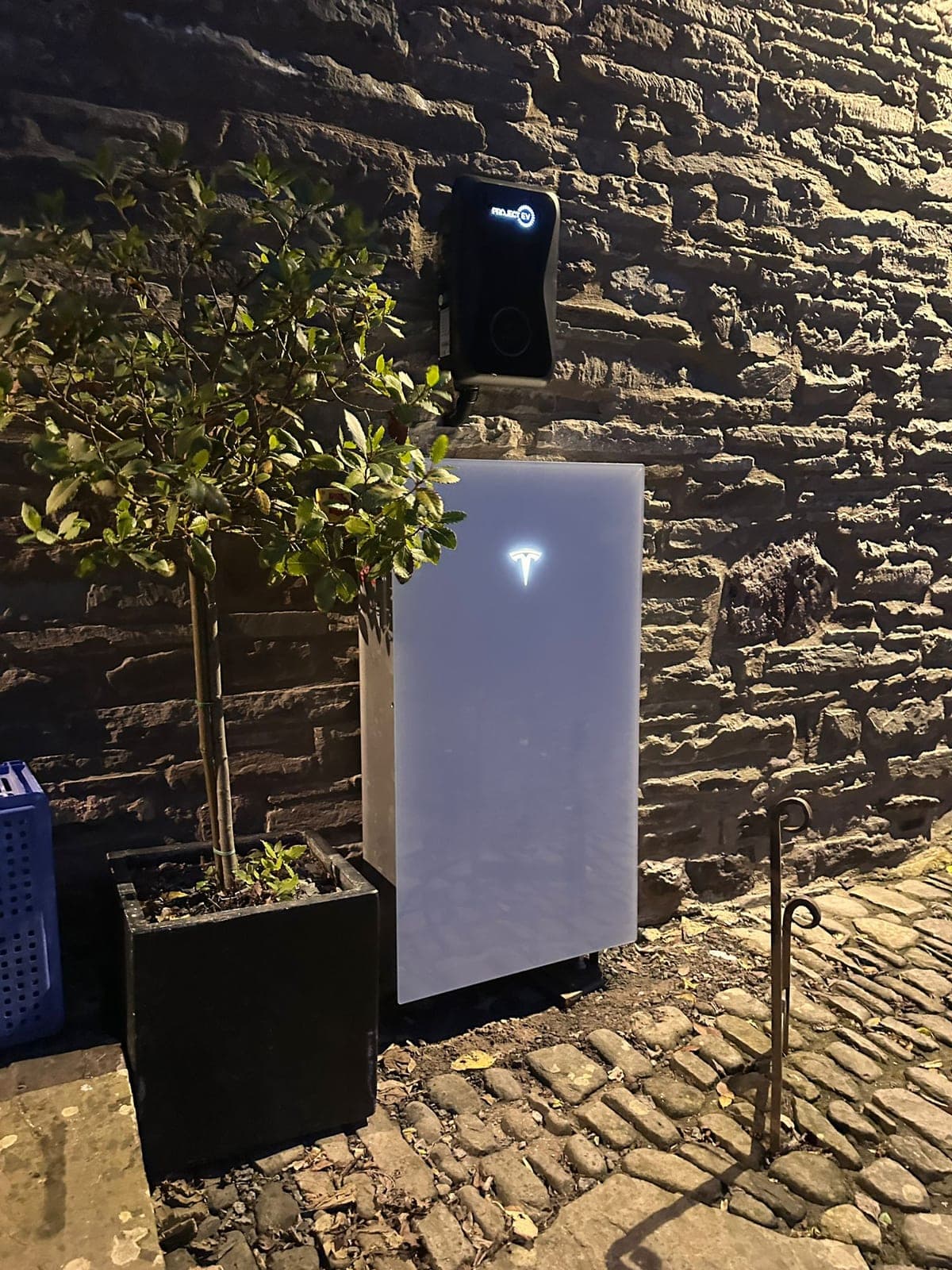
The Tesla Powerwall 3 arrived in the UK in June 2024 and is the most significant upgrade in the Powerwall line's history. The headline change is a built-in hybrid solar inverter, so the Powerwall 3 replaces your solar inverter entirely rather than sitting alongside one. For new solar-plus-storage installs this simplifies the system and removes one point of failure.
| Specification | Detail |
|---|---|
| Usable capacity | 13.5 kWh (100% depth of discharge) |
| Continuous power output | 11.04 kW AC |
| Solar-to-home efficiency (DC-coupled) | 97.5% |
| Solar input | Up to 20 kW DC, 3 MPPT strings |
| Scalable to | 54 kWh (4 units + expansion) |
| Warranty | 10 years, 80% capacity retention |
| IP rating | IP67 |
| Operating temperature | -20°C to +50°C |
Where it excels: the 11.04 kW continuous output is the standout figure here. Most home batteries deliver 3 to 6 kW; the Powerwall 3 can run a heat pump, EV charger, and the rest of the house at once without grid top-up. The 97.5% DC-coupled efficiency is the highest in this guide.
Where it falls short: it is the most expensive option here. Retrofitting it alongside an existing third-party inverter means AC-coupled mode, dropping efficiency to 89%. Whole-home backup needs the optional Backup Gateway (approximately £900 extra).
Installer's view: the right choice when installing solar and battery together from scratch, or for high-demand homes running heat pumps and EV charger installation. Not the best value for a standalone retrofit. See our Tesla Powerwall 3 case study for a real whole-home install.
GivEnergy
Installed price range: £4,500 to £7,000 (All-in-One range, depending on capacity)
GivEnergy is the UK's most widely installed home battery brand. The All-in-One series integrates the hybrid inverter and battery into a single wall-mounted cabinet, in 5 kWh, 8.2 kWh, and 9.5 kWh configurations, scalable later to roughly 30 kWh.
| Specification | Detail |
|---|---|
| Usable capacity | 9.5 kWh (100% depth of discharge) |
| Continuous power output | 6 kW |
| Round-trip efficiency | 92 to 95% |
| Chemistry | LFP (LiFePO4) |
| Cycle life | 6,000+ cycles |
| Warranty | 12 years (battery and inverter) |
| IP rating | IP65 |
| Tariff integration | Native Octopus Agile, Flux, Intelligent |
GivEnergy's real advantage is its software. The Cloud app offers granular real-time monitoring, tariff scheduling, and remote management, with native Octopus Agile, Flux, and Intelligent compatibility built in rather than bolted on.
Where it excels: budget-conscious buyers who want proven technology, homes already on Octopus tariffs, and anyone who wants to start small and expand later. Its 12-year warranty was the longest in this comparison, though with GivEnergy now in administration that cover is no longer honoured.
Where it falls short: the 6 kW output of the 9.5 kWh All-in-One is lower than the Powerwall 3's 11 kW, which can limit homes running a heat pump and EV charger at once.
Installer's view: the most versatile system for the widest range of homes, particularly strong for tariff shifting and scalable retrofits.
Fox ESS
Installed price range: £3,500 to £7,000 (depending on capacity)
Fox ESS has a dedicated UK office and an established installer network, and is approved by MCS for certified installations. The EP range is the most popular choice for UK homes, with the newer EP6 Plus adding built-in fire suppression and a self-heating element for cold UK weather.
| Specification | Detail |
|---|---|
| Usable capacity | 5.18 kWh per unit (90% depth of discharge) |
| Round-trip efficiency | 95%+ |
| Chemistry | LFP (LiFePO4) |
| Cycle life | 4,000+ cycles (EP range) |
| Scalable to | 23.04 kWh (4 units in parallel) |
| Warranty | 10 years, 70% capacity retention |
| IP rating | IP65 |
| Operating temperature | -25°C to 55°C |
Fox ESS batteries are consistently 30 to 40% cheaper than the Powerwall 3 for comparable capacity, and the system is on the Intelligent Octopus Flux approved list, enabling automated export during the 4 to 7pm peak window.
Where it excels: cost-conscious buyers who want LFP quality without premium pricing, three-phase properties, and precise capacity sizing. The EP6 Plus self-heating is a practical advantage outdoors.
Where it falls short: the app and monitoring is functional but less polished than GivEnergy or Tesla, and the 90% depth of discharge means you lose 10% of stated capacity versus the Powerwall 3's 100%.
Installer's view: the best value per kWh of storage for cost-conscious buyers, and a strong choice for three-phase properties.
EcoFlow PowerOcean
Installed price range: £4,500 to £8,000 fully installed (single-phase, 5 to 15 kWh)
The EcoFlow PowerOcean is a purpose-built home battery system, distinct from EcoFlow's portable power stations. The single-phase version offers 5 to 15 kWh with a 6 kW inverter; the three-phase version scales to 45 kWh. It uses modular 5 kWh packs with a built-in DC-DC converter in each, so a single pack failure does not take the whole system down.
| Specification | Detail |
|---|---|
| Usable capacity | 5 to 15 kWh (modular, 5 kWh packs) |
| Continuous power output | 6 kW |
| Chemistry | LFP (LiFePO4) |
| Cycle life | 6,000 cycles to 70% capacity |
| Warranty | 15 years |
| IP rating | IP65 |
| Depth | 188mm (slim profile) |
The PowerOcean's standout feature is its 15-year warranty, the longest in this comparison by a clear margin. The slim 188mm profile makes it practical where other systems would not fit.
Where it excels: homeowners who want the longest warranty available, space-constrained properties, and three-phase homes with high storage needs.
Where it falls short: EcoFlow is a newer entrant to permanent home installation, so its UK track record is shorter than GivEnergy or Fox ESS, and tariff integration is less mature than GivEnergy's native Octopus compatibility.
Installer's view: a strong option for three-phase properties and buyers who prioritise warranty length. For most single-phase homes, GivEnergy or Fox ESS offer more mature software at comparable cost.
How do the best home batteries compare in 2026?
All prices are estimates for fully installed systems in 2026. Actual costs vary by installer, location, and installation complexity. 0% VAT applies to qualifying residential installations.
| Tesla Powerwall 3 | GivEnergy AiO 9.5 kWh | Fox ESS EP6 Plus x3 | EcoFlow PowerOcean | |
|---|---|---|---|---|
| Usable capacity | 13.5 kWh | 9.5 kWh | 15.5 kWh nominal | 5 to 15 kWh |
| Continuous output | 11.04 kW | 6 kW | 5+ kW | 6 kW |
| Round-trip efficiency | 97.5% DC / 89% AC | 92 to 95% | 95%+ | Not independently published |
| Battery chemistry | LFP | LFP | LFP | LFP |
| Depth of discharge | 100% | 100% | 90% | 100% |
| Warranty | 10 years | 12 years | 10 years | 15 years |
| IP rating | IP67 | IP65 | IP65 | IP65 |
| Integrated inverter | Yes (DC-coupled) | Yes (All-in-One) | Yes (H1/H3) | Yes |
| Backup power | Yes (Gateway, ~£900) | Yes (EPS) | Limited | Yes |
| Octopus integration | Yes | Native | Flux approved | Partial |
| Installed price (approx.) | £7,395 to £11,000 | £5,800 to £7,000 | £5,500 to £6,500 | £4,500 to £8,000 |
| Best for | New solar + high demand | Tariff shifting, retrofits | Best value per kWh | Long warranty, slim |
Which home battery is right for your situation?
The comparison table shows what each system does. This section explains which one fits your circumstances.
Solar-first homes (maximising self-consumption)
If your goal is to store as much of your own solar generation as possible, efficiency and capacity matter most. Recommended: Tesla Powerwall 3 for a new solar install, or GivEnergy 9.5 kWh for existing solar or a tighter budget. The Powerwall 3's 97.5% DC-coupled efficiency makes it the clear leader for new installs; GivEnergy's 92 to 95% is competitive for retrofits at a lower price.
Tariff shifters (Octopus Agile, Flux, or Intelligent)
Time-of-use tariffs let you charge during cheap overnight periods and use or export during expensive peaks. Octopus Agile rates can drop below 5p/kWh overnight. Recommended: GivEnergy for the best native tariff integration, or Fox ESS on Intelligent Octopus Flux, which can automate export during the 4 to 7pm peak at rates up to roughly 30p/kWh.
Backup power priority
For homes that experience frequent power cuts, output power and switchover speed are critical. Recommended: Tesla Powerwall 3 with Backup Gateway (11.04 kW continuous, automatic switchover), or the EcoFlow PowerOcean three-phase version (up to 12 kW) for larger properties.
Retrofit vs new install
- If you have an existing GivEnergy or Fox ESS inverter, adding a compatible battery module is the most cost-effective upgrade.
- If you have a different brand's inverter, the AC-coupled GivEnergy and Fox ESS can connect without replacing it.
- The Powerwall 3 in AC-coupled mode loses its efficiency advantage and costs significantly more, so it is rarely the best value for a straight retrofit.
Installer's note: a battery sized correctly for your home and tariff will outperform an oversized premium system used inefficiently. We always recommend a consumption assessment before specifying capacity.
What should you look for when choosing a home battery system?
Beyond brand names and headline specs, several factors determine whether a system performs well over its lifetime.
Usable capacity vs stated capacity
Manufacturers quote nominal (total) capacity, but usable capacity after depth of discharge is what you actually get. A battery with 5.76 kWh nominal at 90% delivers 5.18 kWh in practice. The Powerwall 3's 100% depth of discharge means its stated 13.5 kWh is genuinely available. The average UK household uses about 10 kWh per day, so a 9.5 to 13.5 kWh battery can cover most of a day's demand.
Continuous power output
Capacity tells you how long the battery lasts; output tells you what it can run at once. A 6 kW battery cannot simultaneously run an air source heat pump (3 to 5 kW) and a 7 kW EV charger without grid top-up; an 11 kW battery can. For most homes without a heat pump or EV charger, 5 to 6 kW is plenty.
Round-trip efficiency
Every time you store and retrieve energy, some is lost. A 90% efficient battery loses 10%; a 95% battery loses 5%. Over 10 years of daily cycling this accumulates, so if maximising solar self-consumption is your goal, efficiency matters more than most buyers realise.
Warranty terms
A 10-year warranty is the market standard, but terms vary. Before signing, check what capacity is guaranteed at end of term (usually 70 to 80%), whether the warranty covers both battery and inverter, whether registration is required after installation, and who handles UK warranty claims.
Smart tariff compatibility
If you are on or moving to a time-of-use tariff, verify the system supports it natively. Native integration means automatic scheduling without manual intervention. Check this with your installer before committing to a brand.
Installation location and IP rating
- IP67 (Powerwall 3): suitable for indoor and outdoor installation.
- IP65 (GivEnergy, Fox ESS, EcoFlow): suitable for garages and sheltered outdoor locations.
- Loft installations need care: LFP performs well in the cold, but charging efficiency drops below 0°C on some systems. The Fox ESS EP6 Plus self-heating element addresses this for outdoor UK installs.
The Energy Saving Trust recommends discussing installation location with your installer before specifying the system, as it affects both performance and warranty validity.
Why does your installer's MCS certification matter?
Choosing the right battery is only half the decision. Your installer's certification determines whether the system is eligible for the financial benefits that make home storage worthwhile.
MCS (Microgeneration Certification Scheme) is the UK's national quality assurance framework for small-scale renewables. For battery storage, installers need the battery-storage scope of MCS, which is separate from the solar PV scope. Many solar companies are certified for solar but not for battery storage, so always check that your installer's certification covers the work you are having done.
Smart Export Guarantee (SEG) eligibility
The Smart Export Guarantee requires large energy suppliers to pay homeowners for the electricity they export. Current SEG rates range from about 4p to 15p per kWh depending on supplier and tariff. The critical rule: without an MCS certificate issued at installation you cannot apply for SEG payments, and the certificate cannot be added retroactively. If your installer is not MCS-certified, your surplus solar energy goes to the grid for free.
VAT and government scheme access
MCS certification is also required to confirm eligibility for 0% VAT on residential battery installations, and it is a prerequisite for schemes such as ECO4 and the Home Upgrade Grant where battery storage is included.
Djuka Electrics is an MCS-certified installer for solar PV and battery storage. Every installation we complete is registered with MCS and comes with a full certificate issued at handover. We also handle the DNO connection notifications (G98 and G99) as part of the installation, a step that uncertified installers often leave to the homeowner.
Our honest summary
The right battery for your home depends on your solar setup, energy usage, tariff, and priorities. There is no substitute for a proper site survey before recommending a system. From an installer's perspective:
- Tesla Powerwall 3 earns its price tag for new solar installations and high-demand homes running heat pumps and EV chargers.
- GivEnergy is the most versatile system for the widest range of homes, particularly for tariff shifting and scalable retrofits.
- Fox ESS delivers the best value per kWh of storage for buyers who do not want to compromise on LFP quality.
- EcoFlow PowerOcean is the strongest option for three-phase properties and buyers who want the longest warranty on the market.
Djuka Electrics is an MCS-certified installer based in Beoley, Redditch, serving homeowners across Worcestershire and the West Midlands, including Redditch, Bromsgrove, Worcester, Kidderminster, Solihull, and Birmingham. We install all four systems covered in this guide and will recommend the one that genuinely suits your situation. You can see real installs in our solar and battery case studies, or request a free battery storage quote and site assessment.