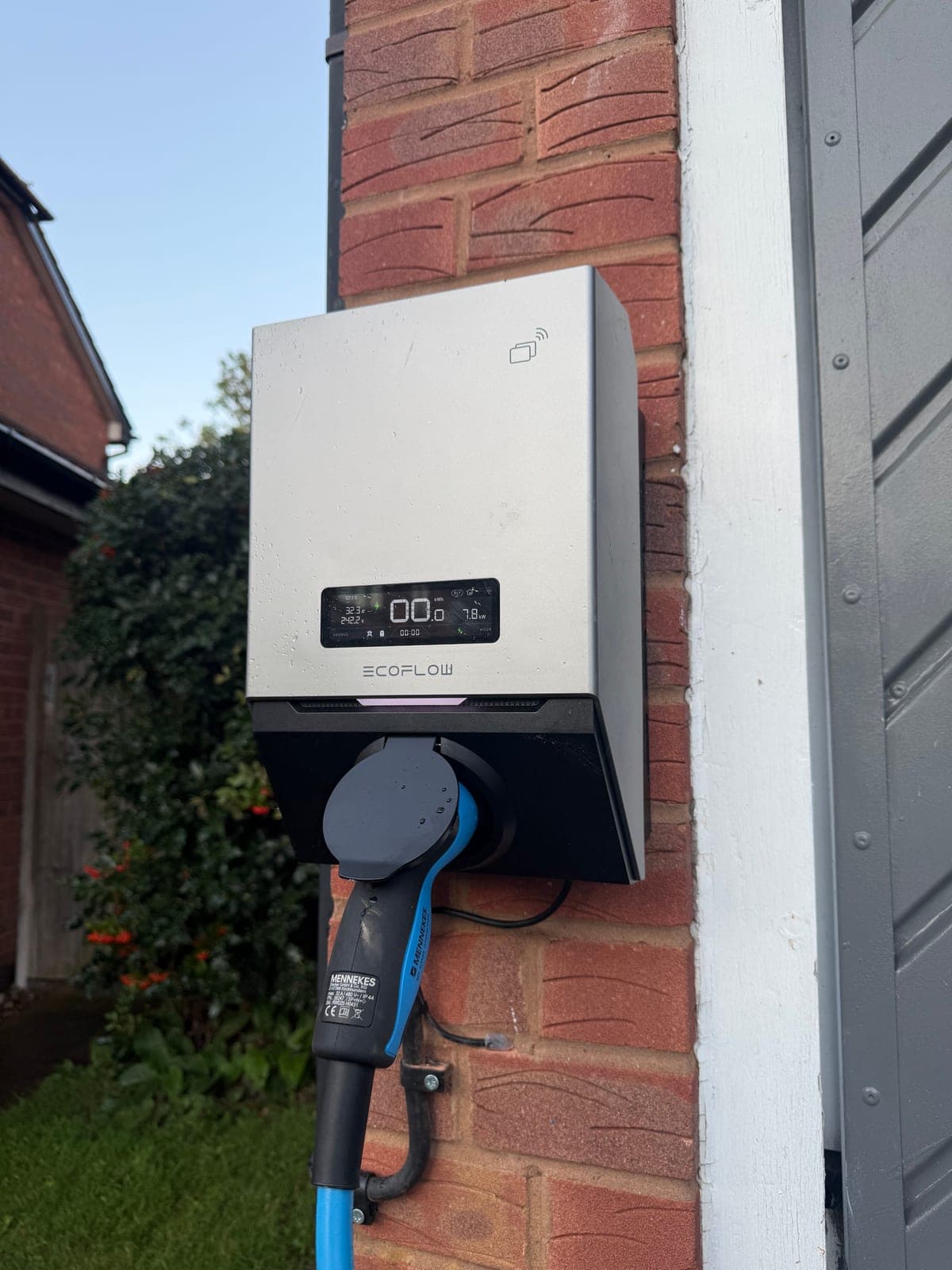
How does home EV charger installation work?
A home charger is a dedicated circuit, not a plug socket. The installer runs a cable from your consumer unit to the charge point, fits the necessary protection, and commissions the unit.
A typical install involves: - Checking your incoming supply and consumer unit can support a charger. - Running a dedicated cable to the chosen location. - Fitting the charge point and the required electrical protection. - Testing, commissioning, and showing you how to use it.
Most domestic installs are completed in a few hours, depending on cable run and any upgrades needed.
What affects the cost of an EV charger installation?
The charger unit itself is one part; the installation is the other. The main variables are: - Cable run: the further the charge point is from your consumer unit, the more cable and labour. - The route: a clean run along a wall is cheaper than one needing trenching or going under a drive. - Your consumer unit: older boards may need work to add the circuit safely. - The charger model: tethered or untethered, and the smart features you want.
We survey the route and your supply before quoting, so the written price reflects your actual home rather than a generic estimate.
Are there still grants for home EV chargers?
The original home charger grant for homeowners in houses with off-street parking closed some years ago. However, targeted grants have continued for specific groups, which at the time of writing have included: - Renters and flat owners. - Households relying on on-street parking. - Landlords installing chargers for tenants.
Eligibility and the exact schemes change over time, so we check what currently applies to your situation and tell you honestly rather than promising a grant that may no longer fit.
Do I need a special charger for my car?
Most home chargers in the UK are 7kW units with a Type 2 connector, which suits the vast majority of electric and plug-in hybrid cars. You do not generally need a charger matched to a specific brand of car.
The choice is mainly about: - Tethered (cable attached) versus untethered (you use your own cable). - Smart features such as scheduling to cheap overnight tariffs and app control. - Load management, which lets the charger ease off when the rest of the house is drawing heavily.
How do I choose the right home charger?
Think about how you live with the car: - If you want to plug in and forget, a tethered unit is convenient. - If you want the lowest running cost, choose a smart charger that schedules to an off-peak EV tariff. - If you have solar, a charger that can use surplus solar to charge the car is a strong pairing. - If your supply is tight, load management avoids the need for a costly supply upgrade.
We fit a range of leading chargers and recommend based on your car, your tariff, and your home rather than whatever we have in the van.
Can I charge from my solar panels?
Yes. Certain chargers can divert surplus solar generation into the car, so you top up using electricity you have already produced. If you have or are planning solar, this is one of the best ways to cut motoring costs, and we can design the two systems to work together.