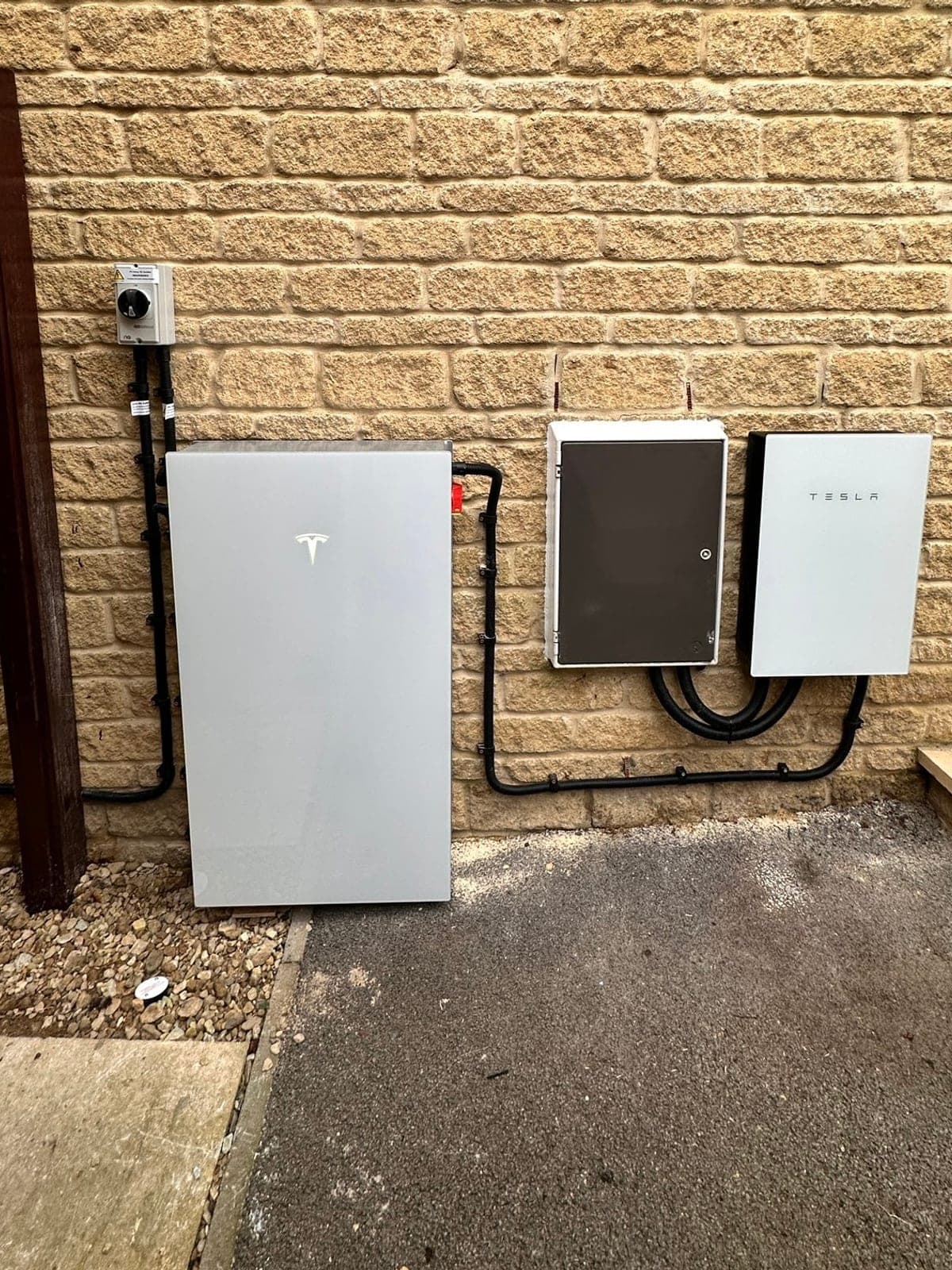
Powerwall 3 vs GivEnergy at a glance
| Tesla Powerwall 3 | GivEnergy (Giv-Bat range) | |
|---|---|---|
| Usable capacity (single unit) | 13.5 kWh | 2.6 kWh to 9.5 kWh |
| Maximum continuous output | 11.04 kW | 6.1 kW (9.5 kWh unit) |
| Battery chemistry | LFP (lithium iron phosphate) | LFP (lithium iron phosphate) |
| Inverter included | Yes, built-in hybrid inverter | Separate hybrid inverter required |
| Scalability | Up to 4 units (54 kWh) | Up to 5 batteries per inverter |
| Whole-home backup | Yes (with Gateway or Backup Switch) | Yes (with Gateway, adds cost) |
| Warranty | 10 years | 10 to 12 years (see administration note) |
| 0% VAT eligible | Yes | Yes (when installed with solar) |
| Installed price range (approx.) | £7,500 to £11,000 | £4,500 to £7,000 |
| Current trading status | Active | In administration |
What does each system actually do?
Both systems store electricity so you can use it when you need it, rather than when the sun is shining or when grid rates are cheapest. But how they are built, and the situations they are designed for, differ.
Tesla Powerwall 3
The Powerwall 3 is an all-in-one unit. The battery and a full hybrid solar inverter are built into a single box, so if you are installing solar at the same time you do not need a separate inverter. That saves cost and reduces the number of boxes on your wall.
The standout number is the 11.04 kW continuous output, enough to run a heat pump, an oven, and an EV charger at the same time without the battery struggling. Most home batteries deliver 3.6 kW to 6 kW, so the Powerwall 3 is genuinely in a different category for power delivery. It connects to the Tesla app for real-time monitoring, tariff scheduling, and backup reserve control, and can participate in smart tariffs such as Octopus Intelligent.
GivEnergy (Giv-Bat range)
GivEnergy's approach is modular: you buy a hybrid inverter separately and attach one or more battery modules. The most popular unit for a typical three-bedroom home was the 9.5 kWh Giv-Bat Gen 3, which uses lithium iron phosphate (LFP) chemistry, generally considered safe and slow to degrade. The modular design means you can start small and add capacity later without replacing the inverter, and systems are monitored through the GivEnergy Cloud portal.
Key difference: the Powerwall 3 is a single integrated unit optimised for high power output and simplicity. GivEnergy is a modular system optimised for flexibility and cost-per-kWh. Note the administration status below before choosing GivEnergy for a new install.
Which is better for whole-home backup?
This is the question we hear most often, and the Powerwall 3 has a clear advantage.
The 11.04 kW continuous output means a single Powerwall 3 can handle almost any combination of appliances at once. It can start heavy motor loads up to 185 LRA (locked rotor amps), which covers most heat pumps, and switchover when the grid drops is near-instant. If you have a heat pump, an induction hob, and an EV charger all running during a power cut, a single Powerwall 3 can keep all three going. A standard 9.5 kWh GivEnergy unit, at 6.1 kW output, would struggle with that.
The Powerwall 3 needs either the Gateway 3 or the Backup Switch to enable whole-home backup. Tesla's Powerwall 3 datasheet confirms up to 4 stacked units and 185 LRA motor start. GivEnergy systems can also provide backup but require the GivEnergy Gateway, and backup is single-phase only, with the 6.1 kW ceiling enough for lights, a fridge, a TV and charging, but not a heat pump and oven together.
- Powerwall 3: best choice if whole-home backup during an outage is a priority, especially with high-demand appliances.
- GivEnergy: adequate for essential-circuit backup; less suited to homes with heat pumps or high simultaneous loads.
- Both: single-phase backup only.
Can I retrofit either battery to existing solar?
Yes, both can be added to an existing solar installation, but the process and cost differ depending on your current inverter.
AC coupling is the simpler, more common approach. The battery connects to your consumer unit independently and works alongside your existing solar inverter rather than replacing it. It works with virtually any existing solar inverter, regardless of brand or age.
DC coupling is more efficient but requires replacing your existing inverter with a hybrid model. It is generally only worth it if your current inverter is near end-of-life, or if you are installing solar and battery together from scratch.
The Powerwall 3 has a built-in inverter, which suits new solar installs; for retrofits to existing solar it connects via AC coupling, leaving your inverter in place. One thing to check: the built-in inverter only adds value if you are installing new panels at the same time. GivEnergy retrofit routes:
| Your existing setup | Best retrofit option |
|---|---|
| No inverter (new solar install) | Hybrid inverter + battery in one go |
| Existing GivEnergy hybrid inverter | Add battery modules directly |
| Existing non-GivEnergy hybrid inverter | AC coupling (battery with its own inverter) |
| Standard string inverter (pre-2018 or non-hybrid) | AC coupling, or replace with a hybrid |
| Microinverter system (e.g. Enphase) | AC coupling only |
For most West Midlands homeowners with solar fitted in the last five years, you probably have a string inverter and AC coupling is the most straightforward path. If you are unsure what inverter you have, it is on a label on the unit (usually in the garage, utility room, or loft), and we check this as part of every free survey.
Which home types suit each system?
After installing batteries across Redditch, Birmingham, Bromsgrove, and the wider West Midlands, we have a clear sense of which homes suit each.
Where the Powerwall 3 tends to be the better fit
- New solar plus battery installations where the integrated inverter saves the cost of a separate unit.
- Homes with a heat pump or other high-demand appliances where the 11.04 kW output matters.
- Larger properties with higher daily consumption (the 13.5 kWh single-unit capacity covers more).
- Homeowners who want power-cut resilience for the whole home, not just a few circuits.
- Homes planning to scale up with additional Powerwall units in future.
Where GivEnergy historically fit best
- Budget-conscious retrofits where a 9.5 kWh battery at a lower entry price made more sense than a 13.5 kWh unit.
- Homes with existing GivEnergy inverters where adding battery modules is plug-and-play.
- Properties wanting to start small and expand with smaller modules over time.
The caveat that changes things
The administration of GivEnergy Ltd changes the calculus for new installations. For most homeowners asking us today, we recommend the Powerwall 3 as the primary choice, with Fox ESS as the alternative where the Powerwall's price point is a barrier. If you already have a GivEnergy system installed and working well, there is no need to change anything: the hardware is sound and the portal still works.
What does each system cost?
We do not publish fixed prices, because every installation differs with your property, consumer unit, any switchgear upgrade, and whether you combine it with new solar panel installation. What we can give is a realistic market range.
Tesla Powerwall 3 installed cost
A fully installed Powerwall 3, including commissioning and switchgear, typically falls in the range of £7,500 to £11,000 for a single unit. The lower end applies to straightforward installs alongside new solar (the integrated inverter saves hardware cost); the upper end reflects complex retrofits, larger properties, or the full Gateway 3 for backup. A two-unit system (27 kWh, 22 kW) typically runs £13,000 to £18,000 installed.
GivEnergy installed cost
GivEnergy systems have historically been positioned £2,000 to £3,000 below the Powerwall for comparable capacity. A 9.5 kWh package (hybrid inverter plus battery) has typically cost £4,500 to £7,000 fully installed. These figures are for context; with the company in administration we are not quoting new GivEnergy installs.
VAT: what the 0% rate means
Battery storage installed as part of a solar PV system qualifies for 0% VAT under HMRC's energy-saving-materials rules, for both Tesla and GivEnergy systems when supplied and installed together with solar under a single contract. If you add a battery to an existing solar system under a separate contract, standard 20% VAT applies, which can add £900 to £1,400 to the cost.
The Energy Saving Trust estimates a typical home battery can save between £200 and £500 per year when used alongside solar, depending on household size and tariff. At those rates, payback on the battery element of a combined install typically falls between 8 and 12 years.
The GivEnergy administration: should you still consider it?
This is the question we are asked most in 2026, and it deserves a straight answer.
GivEnergy Ltd entered administration in April 2026. The hardware continues to function and the GivEnergy Cloud portal remains operational for now, but the company has ceased trading, all staff were made redundant, and GivEnergy is no longer honouring hardware warranties or providing software support.
If you already have GivEnergy
Your system continues to work and the monitoring remains available for now. However, with GivEnergy no longer trading, manufacturer-backed warranty cover and support are no longer available, so contact your original installer in the first instance for any issue. There is no need to remove a working system.
If you are considering a new GivEnergy installation
We would not recommend it, and we are not quoting it for new projects. The hardware itself is fine, but a 10 to 12-year product decision should come with a manufacturer that is actively trading and able to support firmware, parts, and warranty claims for the full term. This is not a criticism of the product; GivEnergy made excellent batteries. It is purely about long-term support confidence.
What we recommend instead
- Tesla Powerwall 3 for homes that can stretch the budget and want the best backup performance.
- Fox ESS for buyers who want a GivEnergy-style modular approach from a manufacturer that is actively trading and well supported in the UK, including three-phase options for larger homes.
You can see what we currently install on our battery storage page.
Honest installer verdict: which should you choose?
We have installed both systems and have no financial incentive to push one over the other. Here is what we actually think.
Choose the Powerwall 3 if
- You are installing solar and a battery together (the integrated inverter makes it the most cost-efficient all-in-one solution).
- You have a heat pump, induction hob, or EV charger and want genuine whole-home backup.
- You want a single tidy installation with one app and one warranty contact.
GivEnergy now only makes sense if
- You already have a working GivEnergy inverter and simply want to keep it running.
For new installations today, we recommend the Powerwall 3, not because it is the most expensive option, but because it is the better-supported product with the higher power output, and the GivEnergy administration makes new GivEnergy installs difficult to recommend in good conscience.
The 11.04 kW output is not marketing noise: West Midlands homes increasingly have heat pumps, and a 6 kW battery cannot run a heat pump and a kettle at once. The Powerwall 3 can. Its 13.5 kWh capacity also covers the average UK household's daily use (around 8 to 10 kWh) with headroom.
Our recommendation in plain English: if you are starting fresh with solar and battery, get the Powerwall 3. If it is outside your budget, ask us about Fox ESS. If you already own a working GivEnergy system, keep it running, but with GivEnergy no longer trading, any future expansion is better done with a currently-supported brand.
You can read how a real Redditch homeowner made this decision in our Tesla Powerwall 3 case study, which covers the full system, the install, and the numbers. We are an MCS-certified, NAPIT-registered installer in Beoley, Redditch, and we install Tesla Powerwall 3, Fox ESS, and EcoFlow battery systems across the West Midlands and Worcestershire. Every quote is written, itemised, and specific to your home: request your free written quote and we will arrange a survey.